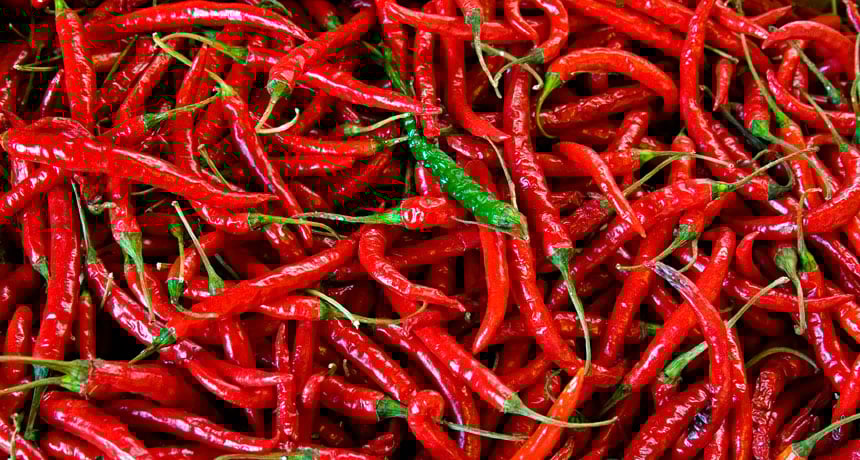
Many traditional Asian dishes make use of chili peppers. One variant was even named chinense because it was believed to have originated in China. But did you know where chili peppers actually come from?
Asian regions such as India, China, and Thailand are known for their spicy dishes, but they only discovered and used chili peppers in the 1500s, at the start of worldwide sea trading. Chili peppers came from South America.
You might also enjoy: A 2017 Study Found that the Introduction of Iodized Salt in 1924 Raised the IQ for a Quarter of the Population Most Deficient in Iodine.
Origin of Chili Peppers
With the scientific name Capsicum annuum, chili peppers are part of the Solanaceae family, including tomatoes, potatoes, and aubergines. According to historians, the first gene of chili peppers emerged some 16.8 million years ago in Bolivia. At the time, the pepper was theorized as not to be spicy.
The fruit only developed its spiciness after being in existence for 3 million years. Between 1200 and 1450, carbonized seed dating provided evidence that the pepper was domestically grown and used in the Americas and Mexico.
In 1492, Christopher Columbus discovered the peppers upon his voyage to the New World, encountering the aji chile in the Carribeans. He labeled them peppers as they resembled the spicy quality similar to peppercorns they were looking for. (Source: Chile Peppers)
A few years later, the said peppers were introduced to Asian regions such as India, Morocco, and China, thanks to the growing global sea trades. It soon was introduced to many cultures as it was one of the products commonly found on the Silk Road, a network of trade routes that connected the eastern and western hemispheres.
Today, chili peppers are a staple ingredient of many cultures, such as Indian curries, Chinese Sichuan dishes, and Thailand’s favorite soup, the tom yum kung. (Source: Alimentarium)
Notorious Chili Peppers
Today, many kinds of chili peppers are grown and harvested, and there have been several variations that bring the heat. These peppers are ranked highest on the Scoville Scale. This scale is used to quantify how spicy a pepper is by measuring the concentration of capsaicinoids. It is the chemical responsible for the spicy sensation within the fruit.
The original Red Tabasco sauce is at 3,750 Scoville Heat Units or SHU to further understand how spicy these examples are. The chili peppers scored significantly more.
- Trinidad Scorpion Butch T – SHU score of 1,463,700. It was the 2011 Guinness World Record Holder for spiciest chili pepper cultivated by Butch Taylor in Australia.
- 7 Pot Primo – SHU score of 1,469,000 and was created by horticulturist Troy Primeaux.
- 7 Pot Douglah – SHU score of 1,853,936 and is the only super hot pepper that is brown. Most super hot peppers are red.
- Trinidad Moruga Scorpion – SHU score of 2,009,231. This pepper is native to the lands of Moruga in Trinidad and Tobago. This pepper was just recently discovered.
- Carolina Reaper – 2,200,000 SHU score and is known as the hottest pepper in the world. This pepper ranked as the world’s hottest pepper in 2013 and 2018. It is a cross between the Ghost Pepper and Red Habanero peppers. The Carolina Reaper is two hundred times hotter than a Jalapeno to put context to how spicy it is.
(Source: PepperHead)